
About Gaïago
Since 2014, Gaïago has developed solutions that stimulate the life of agricultural soils (bacteria, fungi, soil fauna) to restore their natural fertility. Their flagship product, Nutrigeo, is now deployed on several hundred French and European farms. The associated carbon programme allows farmers engaged in a regenerative transition to financially value the tonnes of CO₂ sequestered in their soils, through a recognised certification system: Gold Standard (for eligible cohorts) or ISO (for those outside the Gold Standard eligibility window or stratification criteria). MRV relies on direct measurement of soil carbon following the FAO protocol, complemented by satellite dMRV monitoring (Regrow) and independent verification.
Why Arka curates them
Portfolio mostly certified under Gold Standard SOC 402.3, complemented by an ISO 14064-2 track verified by DNV for farms outside the GS eligibility window. 100% European footprint, grounded farmer narrative, full transparency and traceability from the tonne down to the parcel.
Why Gaïago leads
Direct soil carbon measurement
Field sampling per FAO 2020 protocol, verified by accredited Gold Standard third party
+3 tCO₂e/ha/yr removal
Average performance measured across 5,000 ha, top of the European range for soil carbon
A viable transition for the farmer
Carbon revenues of about €100/ha/yr measured on cohort 1, covering the bulk of transition costs. Combined with higher agricultural yields, the bottom line is a net win for the farmer.
What these credits represent
Methodological framing, mapped to the integrity dimensions of the ICVCM Core Carbon Principles.
Soil-sequestered removal
Credits classified as removal under Gold Standard SOC 402.3. Carbon is sequestered in the soil after biostimulant application, measured on the parcel, with no avoidance or avoidance-equivalent logic.
Direct soil sampling, 30 cm
Physical measurement of soil organic carbon stock at the start and end of the crediting period. Minimum depth 30 cm (IPCC standard for mineral soils). FAO 2020 SOC MRV protocol, Annex 3, authorised under 402.3, complemented by satellite dMRV (Sentinel-2/Landsat via Regrow).
Gold Standard 20% buffer
20% of credits retained in the Gold Standard buffer pool to cover reversal risk. Fixed crediting period under the SOC Framework 402, with a post-issuance practice-maintenance requirement.
Accredited third-party, public registry
Validation and verification by an accredited Gold Standard VVB (SustainCert). Annual monitoring, serial numbers traceable to retirement on the public Gold Standard registry.
GS SOC 402.3 is a module of the Gold Standard Soil Organic Carbon Framework, classified as carbon-removal. ICVCM Core Carbon Principles eligibility for the SOC framework is under assessment.
Methodology & verification
Gold Standard SOC Activity Module (402.3) : Soil Organic Carbon from Biostimulants ↗ View the spec
Annual monitoring · VVB verification under Gold Standard rules
Soil sampling at the start and end of the crediting period, following Annex 3 of the FAO 2020 SOC MRV protocol authorised under GS SOC 402.3, complemented by Sentinel-2/Landsat satellite monitoring (dMRV via Regrow) and verification by an accredited third-party (VVB) under Gold Standard rules.
Programme-level agronomic results
Aggregated measurements from Nutrigeo programme cohort 1 (~5,000 ha, 619 observed parcels).
+3.1 tCO₂eq/ha/yr
Average carbon result on the equivalent of 5,000 ha (cohort 1)
+30% fine earth fraction
More porous and less compacted soils, observed on 619 parcels
+70% infiltration+5 to 15 mm extra water stored
Varies between dry and wetter years
+16% fungi+20% mycorrhized roots+29% better-decomposed organic matter
Indicators of microbial fertility and organic-matter cycling
Internal observations from Nutrigeo programme cohort 1 (~5,000 ha, 619 parcels). The tCO₂eq/ha/yr figure is the indicator eligible for certification under GS SOC 402.3; the other measurements are internal programme agronomic indicators. Individual farm performance may vary based on soil type, climate and existing practices.
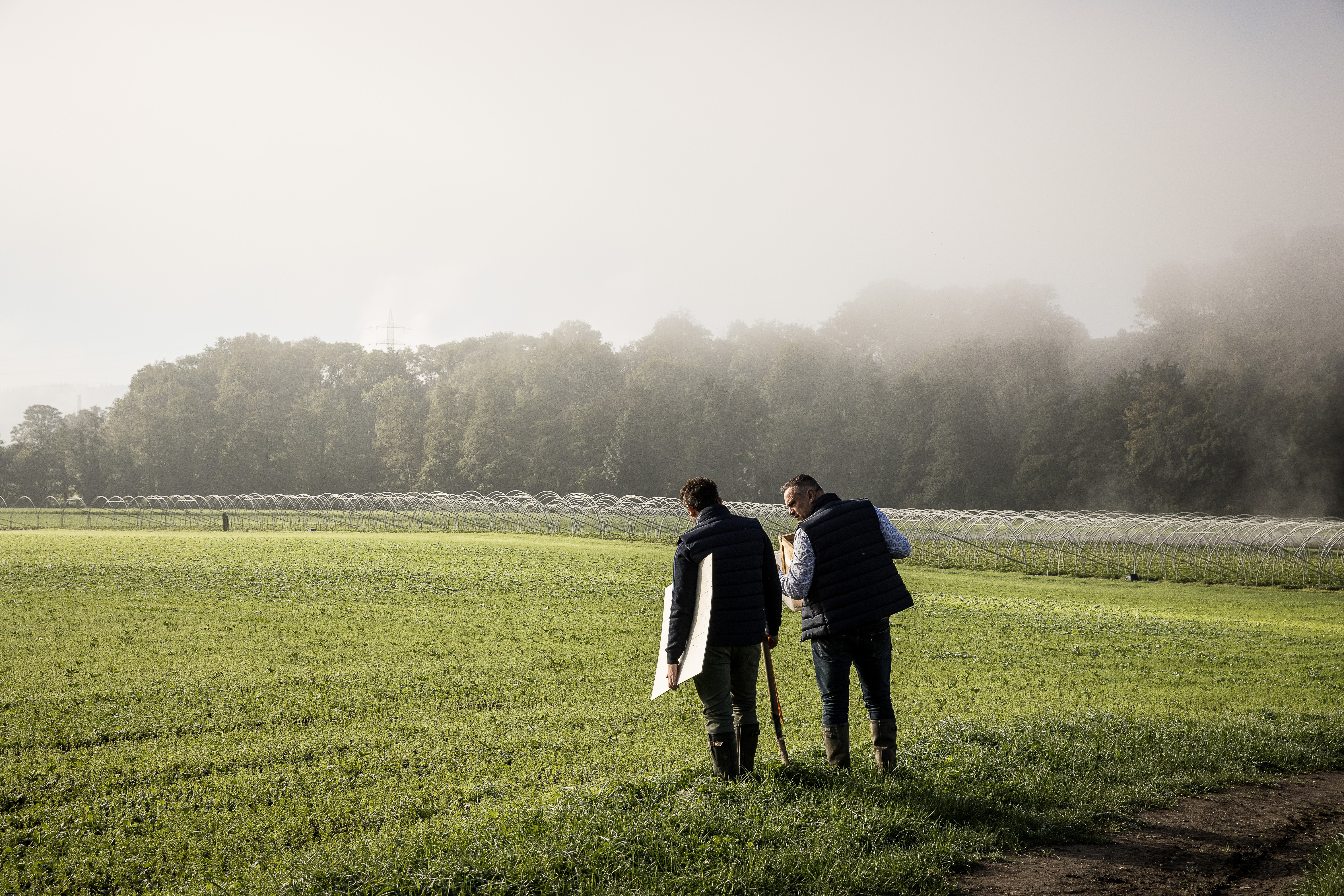
In the field
projects
Beet farm (Grand Est, France)
Gaïago
Agricultural operation spanning 858.6 hectares in Betheniville, Grand Est (France), enrolled since 2023 in the Nutrigeo programme to regenerate its soils.
View projectOilseed farm (Region not specified, Slovakia)
Gaïago
Agricultural operation spanning 236.3 hectares in Blatné, Slovakia, enrolled since 2022 in the Nutrigeo programme to regenerate its soils.
View projectCereal farm (Hauts-de-France, France)
Gaïago
223.5 hectares of cereals (wheat) and flax in Norrent-Fontes, Hauts-de-France (France), in regenerative transition with Gaïago since 2023.
View projectCereal farm (Region not specified, France)
Gaïago
Agricultural operation spanning 214.3 hectares in Henin Beaumont, France (France), enrolled since 2023 in the Nutrigeo programme to regenerate its soils.
View projectBeet farm (Hauts-de-France, France)
Gaïago
199.2-hectare farm in Riencourt-Lès-Cagnicourt, Hauts-de-France (France), specialising in cereals (soft wheat), legumes, sugar beet, potatoes and market gardening, enrolled in the Gaïago carbon programme since 2023.
View projectCereal farm (Wallonia, Belgium)
Gaïago
Farm in Aardenburg, Belgium cultivating cereals (wheat) and flax across 197.3 hectares, on a soil regeneration pathway since 2022.
View projectCereal farm (Burgundy-Franche-Comté, France)
Gaïago
166.8-hectare farm in Andelnans, Burgundy-Franche-Comté (France), specialising in cereals (wheat, barley), rapeseed, legumes and maize, enrolled in the Gaïago carbon programme since 2023.
View projectCereal farm (Occitanie, France)
Gaïago
Farm in Campagne D'Armagnac, Occitanie (France) cultivating maize and vineyards across 84.3 hectares, on a soil regeneration pathway since 2022.
View projectCereal farm (Hauts-de-France, France)
Gaïago
Agricultural operation spanning 147.2 hectares in Méharicourt, Hauts-de-France (France), enrolled since 2022 in the Nutrigeo programme to regenerate its soils.
View projectCereal farm (Normandy, France)
Gaïago
Farm in Les Grandes-Ventes, Normandy (France) cultivating cereals (wheat, barley), rapeseed, flax and maize across 136.5 hectares, on a soil regeneration pathway since 2022.
View projectCereal farm (Occitanie, France)
Gaïago
Farm in Montgazin, Occitanie (France) cultivating cereals (wheat), sunflower, legumes and maize across 135.2 hectares, on a soil regeneration pathway since 2023.
View projectBeet farm (Normandy, France)
Gaïago
126.6-hectare farm in Héberville, Normandy (France), specialising in cereals (soft wheat), rapeseed, flax and sugar beet, potatoes, enrolled in the Gaïago carbon programme since 2022.
View projectAgricultural farm (Centre-Val de Loire, France)
Gaïago
125.4-hectare farm in Marseilles-Lès-Aubigny, Centre-Val de Loire (France), specialising in arable cereals, rapeseed, sunflower, legumes and maize, enrolled in the Gaïago carbon programme since 2022.
View projectCereal farm (Hauts-de-France, France)
Gaïago
123.1-hectare farm in Montay, Hauts-de-France (France), specialising in cereals (wheat) and rapeseed, flax, enrolled in the Gaïago carbon programme since 2022.
View projectAgricultural farm (Nouvelle-Aquitaine, France)
Gaïago
Agricultural operation spanning 119.2 hectares in Arroses, Nouvelle-Aquitaine (France), enrolled since 2023 in the Nutrigeo programme to regenerate its soils.
View projectAgricultural farm (Hauts-de-France, France)
Gaïago
Agricultural operation spanning 118.8 hectares in Frémicourt, Hauts-de-France (France), enrolled since 2022 in the Nutrigeo programme to regenerate its soils.
View projectCereal farm (Flanders, Belgium)
Gaïago
115.6-hectare farm in Spiere-Helkijn, Flanders (Belgium), specialising in cereals (wheat), legumes and maize, enrolled in the Gaïago carbon programme since 2023.
View projectBeet farm (Normandy, France)
Gaïago
111.1-hectare farm in Bertreville-Saint-Ouen, Normandy (France), specialising in cereals (soft wheat), flax, legumes and sugar beet, maize, enrolled in the Gaïago carbon programme since 2022.
View projectBeet farm (Hauts-de-France, France)
Gaïago
Farm in Vitry En Artois, Hauts-de-France (France) cultivating cereals (soft wheat), sugar beet and market gardening across 110.4 hectares, on a soil regeneration pathway since 2022.
View projectBeet farm (Wallonia, Belgium)
Gaïago
Farm in Enghein, Wallonia (Belgium) cultivating cereals (soft wheat) and sugar beet, maize across 106.3 hectares, on a soil regeneration pathway since 2023.
View projectCereal farm (Centre-Val de Loire, France)
Gaïago
Agricultural operation spanning 105.2 hectares in Ouzouer-Sur-Trezee, Centre-Val de Loire (France), enrolled since 2023 in the Nutrigeo programme to regenerate its soils.
View projectCereal farm (Hauts-de-France, France)
Gaïago
103-hectare farm in Rougeries, Hauts-de-France (France), specialising in cereals (wheat), rapeseed and maize, enrolled in the Gaïago carbon programme since 2022.
View projectBeet farm (Hauts-de-France, France)
Gaïago
100.2 hectares of diversified crops in Martinpuich, Hauts-de-France (France), in regenerative transition with Gaïago since 2023.
View projectBeet farm (Hauts-de-France, France)
Gaïago
Farm in Lucheux, Hauts-de-France (France) cultivating cereals (soft wheat), rapeseed and sugar beet, maize across 99.4 hectares, on a soil regeneration pathway since 2023.
View projectDocumentation pack included
Gold Standard serial numbers and public retirement proofs · breakdown by standard, vintage and geography · VCMI claim formulations and ESRS E1-7 alignment for your sustainability report.
Reserve credits from this portfolio
Let us know your interest and we'll get back to you to structure your purchase.